2 October 2026
Debt Collection in Singapore
The article offers information abut debt collection in Singapore. Please contact our lawyers in Singapore for representation in litigation cases.
Debt collection in Singapore must take place in accordance with the local rules and regulations. Our team of lawyers in Singapore can present the current legislation and the manner in which creditors and debtorscan complete the necessary procedures. You can also rely on us if you want to open a debt collection agency.
What is the law applicable to debt collection?
Debt collection is now regulated by its own legal framework, as the local authorities have enacted the Debt Collection Act 2022, which came into force starting with 1st of December 2023. The Act applies to both consumer and commercial debt collection cases.
| Quick Facts | |
|---|---|
| Law on debt collection in Singapore | • the Debt Collection Act 2022 (in force since 1 December 2023) regulates debt collection businesses, while insolvency law regulates certain other matters; |
Amicable settlement available (yes/no) | Yes |
Who can collect debt in Singapore | • the party who needs to recover a sum of money can first address the issue; • then, if the debtor is not responsive, the debt collectors; • cases heard in courts can be represented by lawyers. |
| Code of Conduct for debt collectors (yes/no) | Yes |
| Rules of law applicable to debt collectors | • the Code of Conduct; |
| Overseas debt collection (yes/no) | Yes |
| Rules for overseas debt collection in Singapore | The debt collector has to verify the law applicable in that jurisdiction and will follow the debt collection rules applicable there, while respecting the local timezone. |
| Court proceedings for debt collection (yes/no) | Yes |
| Courts responsible in hearing debt collection cases | • Small Claims Tribunal; • the Magistrate Court; • the District Court; • the High Court. |
| Debt thresholds required to address to a court | For claims with a value of maximum $20,000 the court in charge will be the Small Claims Tribunal. Claims above $250,000 are addressed to the High Courts. |
| How is debt collection initiated | In the amicable agreement stage, the creditor sends a letter to the debtor, in which the outstanding value is evidenced. If the debtor will not provide an answer, the services of the debt collectors/lawyers will be requested by the creditor. |
| Period of time to file a defense | 14 days to file a notice of intention to contest; 21 days to file the defence |
Responsibilities of debt collectors | • contact the debtors; • talk or meet with the debtor; • analyze the financial situation of the debtor; • find a suitable repayment scheme that will suit both parties; • abide by the rules of the Code of Conduct. |
| Fines for debt collectors (yes/no) | Yes, applied for debt collectors who do not respect the Code of Conduct. |
| Legal services on debt collection offered by our lawyers | Assistance on the applicable law and the most suitable option to follow depending on the nature of the client (creditor/debtor), as well as legal representation in court proceedings. |
How can I open a debt collection agency?
Please mind that if you want to start a business in Singapore that has as a main object of activity debt collection you can register the company by following the standard registration procedure applicable to all legal entities. However, you must take into consideration the rules of law established under the Debt Collection Act 2022.
Is it possible to open a business-to-business debt collection agency?
Yes. A business-to-business debt collection agency focuses its activities on resolving debt collection cases arising between companies. You can address our team of lawyers in Singapore for legal assistance on the registration and on any rules of law that you should know when entering this market.
Do I need to obtain a license if I want to start a debt collection agency?
Yes. A part of the mandatory registration process is to obtain proper approvals, which, in this case, are represented by having a suitable license.
What are the conditions for obtaining the debt collection agency license?
The conditions vary based on the type of legal entity your business will operate under. Firstly, it must be noted that the applicant must be at least 21 years old at the moment of the application. His/her function is also of importance, as follows:
- the applicant must be a partner, provided that the legal entity is a limited partnership or limited liability partnership;
- the applicant must be the sole owner in case the company is a sole trader;
- he/she can also be a manager, if the legal entity is a limited liability partnership.
Do I need to pay any license fees?
Yes. License fees are charged for the application and for the license renewal. Currently, according to the Singapore Police Force, the license fee, which is valid for a period of 3 years, costs $600 – the same fee is applied for the renewal.
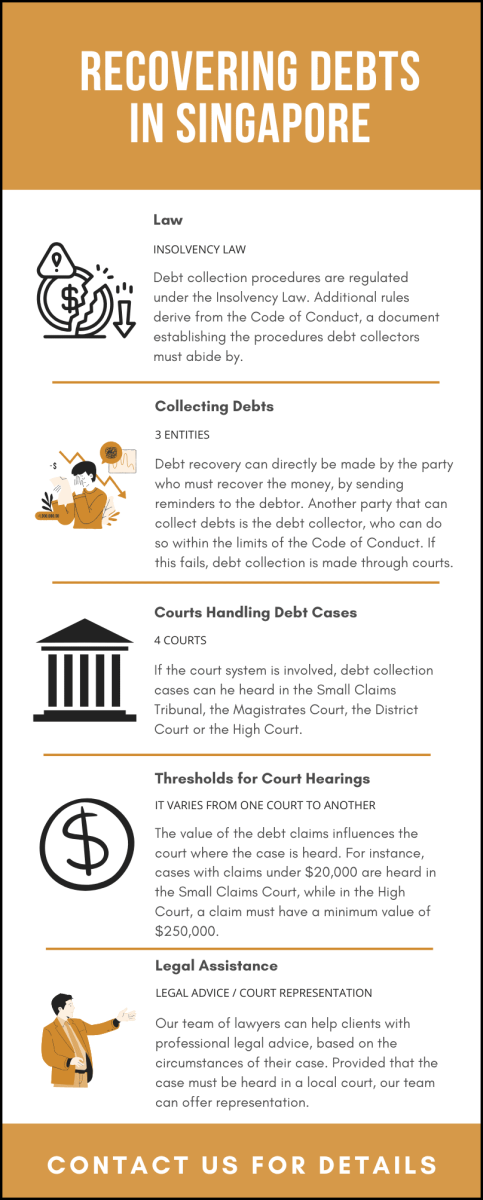
The infographic below shortly presents the process of recovering debts in Singapore:
What is the amicable settlement in debt collection cases in Singapore?
The first step towards debt collection in Singapore is an amicable settlement between parties. If that fails, before starting legal proceedings, an assessment of the company’s assets is important and verification with the Singapore Companies Register is also useful in order to check the company’s activity.
What is the duration of the amicable process?
Amicable settlement procedures can be completed in a period of minimum 30 days to maximum 60.
What are the rules for court proceedings?
The procedure on debt collection in Singapore stipulates that the court where the case will be held will vary based on the amount that has to be collected from a debtor.
What courts can be involved in the debt collection case?
For debts not exceeding S$20,000, the plaintiff may file a petition with the Small Claims Tribunal. Civil cases with debts that do not exceed S$60,000 are handled by the Magistrate Court, while cases in which the debt ranges between S$ 60,000 and S$ 250,000 will be handled by District Courts. The High Court will rule in cases where the amount to be recovered exceeds S$250,000.
What happens in overseas debt collection cases?
The following steps can be started with the assistance of a debt collector specialist or with the help of our lawyers in Singapore:
- the debt collector specialist will verify the legislation on the matter that is applied in the respective country;
- the person will adhere to the rules and regulatory guidance that is imposed in the said country;
- the specialist will verify if certain permits or licenses are needed in accordance with the procedures applicable in the foreign jurisdiction;
- the person must also perform his or her specific work activities in accordance with the time zone of the country where the debtor is;
- the debt collector must also respect any national holiday that is celebrated in that country.
How can debt collectors complete their responsibilities?
Persons who are debtors should know that when they are contacted by debt collection specialists, such persons will follow specific regulations that are prescribed by the Code of Conduct. The Code of Conduct that is applicable when dealing with debt collection in Singapore is more of a guide (since 1 December 2023, however, debt collectors must also comply with the binding conduct rules of the Debt Collection Act 2022) as to how such specialists can conduct their activities.
The video below offers a short presentation on debt collection in Singapore:
What does the Code of Conduct entail?
The Code of Conduct was created by the Credit Collection Association of Singapore, which stipulates that when a debt collector agent will contact in person a debtor, the company hiring the debt collection specialist can’t send more than 5 agents to a person’s address, be it a natural person or a legal entity. However, in practice, most of such cases are handled by a single debt collection specialist.
What consequences can debt collectors face if they harass the debtors?
Debt collectors who harass the debtor can face the following:
- debt collectors who end upphysically hurting the debtor can be charged with a fine of S$ 5,000;
- in severe cases, they can be charged with this fine, but also with an imprisonment of up to 3 years;
- in the case in which a debtor has injuries that can be considered “grievous hurt” due to the harassment of the debt collection specialist, then the latter can receive a sentence of up to 10 years in prison;
- any form of vandalism done by the debt collection agent at the premises of the debtor can be charged with a fine of S$ 2,000;
- in the case in which the person will conclude any action that can fall under the regulations of the Miscellaneous Offences Act in relation with the debtor, a fine of S$ 1,000 will be charged.
You can contact our Singapore law firm for legal representation in litigation cases or debt collection in Singapore.